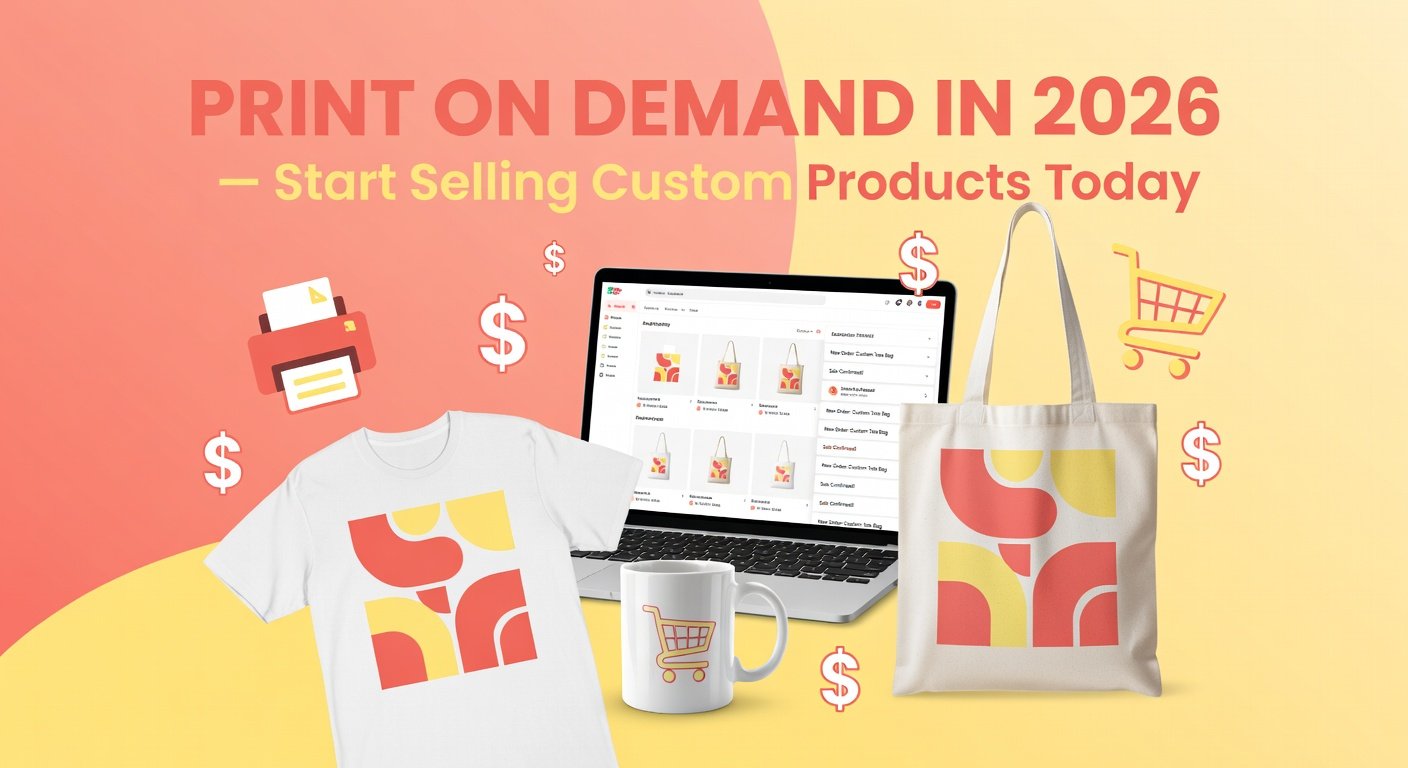
In 2026, print
on demand has become a multi-billion dollar industry, and there's still
enormous room for new sellers. This guide breaks down everything you need to
know to start, grow, and profit from a POD business — even if you have no
design experience.
What Is Print on Demand and How Does It Work
Print on demand
is a business model where products are only printed and produced after a
customer places an order. You create a design, list it on a product, and when
someone buys it, the POD company fulfills the order and ships it directly to
your customer.
You never hold
inventory, pay for products upfront, or deal with shipping logistics. Your
entire job is designing products and marketing them.
Why Print on Demand Is Still Worth It in 2026
•
Zero startup cost — many
platforms are free to join
•
No inventory risk — you
only pay when you make a sale
•
Work from anywhere in the
world
•
Access to hundreds of
product types instantly
•
Passive income potential
once your store is established
•
AI design tools make
great-looking products achievable for non-designers
Step 1 — Choose Your Print on Demand Platform
Top POD Platforms in 2026
•
Printify: Largest product
catalog, competitive pricing, integrates with Etsy, Shopify, and more
•
Printful: Premium quality,
global fulfillment, excellent for brand builders
•
Gelato: Best for
international sellers — local printing reduces shipping times
•
Redbubble: Built-in
marketplace, great for artists
•
Merch by Amazon: Access to
Amazon's massive customer base (invite-only)
•
Teespring (now Spring):
Good for social media creators with existing followings
For beginners,
Printify + Etsy is the most accessible and proven combination.
Step 2 — Choose a Profitable Niche
"Custom
shirts" is not a niche. "Funny camping shirts for retired
teachers" is a niche. The more specific your niche, the better your
marketing, the more loyal your customers, and the higher your conversion rates.
Profitable POD Niches in 2026
1.
Pet lovers (dogs, cats,
specific breeds)
2.
Hobbies and sports (hiking,
fishing, yoga, gaming)
3.
Professions (nurses,
teachers, firefighters, engineers)
4.
Family and relationships
(new parents, grandparents, siblings)
5.
Pop culture references
(without violating copyright)
6.
Motivational and mindset
themes
7.
Local pride (specific
cities, states, countries)
8.
Sarcastic and dark humor
Research your
niche on Etsy before committing. Look at what's selling, what buyers are
searching for, and what designs are getting reviews.
Step 3 — Create Winning Designs
Your design is
what makes or breaks the sale. Here's the truth: you don't need to be a
professional graphic designer to create bestselling POD designs.
Tools for Creating POD Designs
•
Canva Pro: Drag-and-drop
design with thousands of templates
•
Adobe Express:
Professional-quality quick designs
•
Midjourney or DALL-E:
AI-generated art and illustrations
•
Creative Fabrica:
Affordable fonts and graphics
•
Photopea: Free Photoshop
alternative for advanced edits
What Makes a POD Design Sell
•
Readable typography (text
must be clear at thumbnail size)
•
Resonates emotionally with
a specific person (humor, pride, identity)
•
Simple enough to look good
on a shirt or mug
•
Avoids trademarked logos,
phrases, or characters
•
Uses high-contrast colors
that pop on the base product
Step 4 — Set Up Your Online Store
Option A — Etsy Shop
Etsy has
millions of buyers actively searching for custom products. Set up a free Etsy
account, connect your Printify or Printful account, and start listing products.
Etsy charges a $0.20 per listing fee and takes a 6.5% transaction fee on sales.
Option B — Shopify Store
For more
control and branding, build your own store on Shopify. This requires more
marketing effort but gives you higher margins and a brand you fully own.
Option C — Both
Many successful
POD sellers run an Etsy shop for organic discovery traffic while building a
Shopify store for their returning customer base.
Step 5 — Write Listings That Convert
Your product
listing is your silent salesperson. Here's how to make it work:
•
Write a descriptive title
with your niche and main keyword naturally included
•
Start the description with
who the product is for and what occasion it's perfect for
•
List all available sizes,
colors, and materials clearly
•
Add 10 relevant tags (on
Etsy these are crucial for search visibility)
•
Use all available photo
slots — show the product from multiple angles
•
Use Printify's or
Printful's mockup generator for professional photos
Step 6 — Market Your POD Store
Organic Etsy
traffic will come with time, but you can accelerate sales through active
marketing.
•
Pinterest: Pin your product
images with keyword-rich descriptions
•
Instagram and TikTok: Show
the design creation process and product reveal videos
•
Facebook groups: Share in
niche-relevant communities (respectfully)
•
Email list: Collect emails
and announce new designs to loyal fans
•
Etsy Ads: Run low-budget
($1–$5/day) campaigns on your best-performing listings
Realistic Income Expectations for POD
•
Month 1–2: Store setup and
first few sales — $0–$50
•
Month 3–4: Listings gaining
traction — $50–$200/month
•
Month 6–9: Consistent sales
with good reviews — $200–$1,000/month
•
Year 2+: Established shop
with SEO traffic — $1,000–$5,000+/month
Many successful
POD sellers run multiple shops across different niches to multiply their
income.
Final Thoughts
Print on demand
in 2026 is a genuinely accessible, low-risk business model. The combination of
AI design tools, easy-to-use platforms, and global e-commerce infrastructure
means anyone with creativity and persistence can build a profitable store.