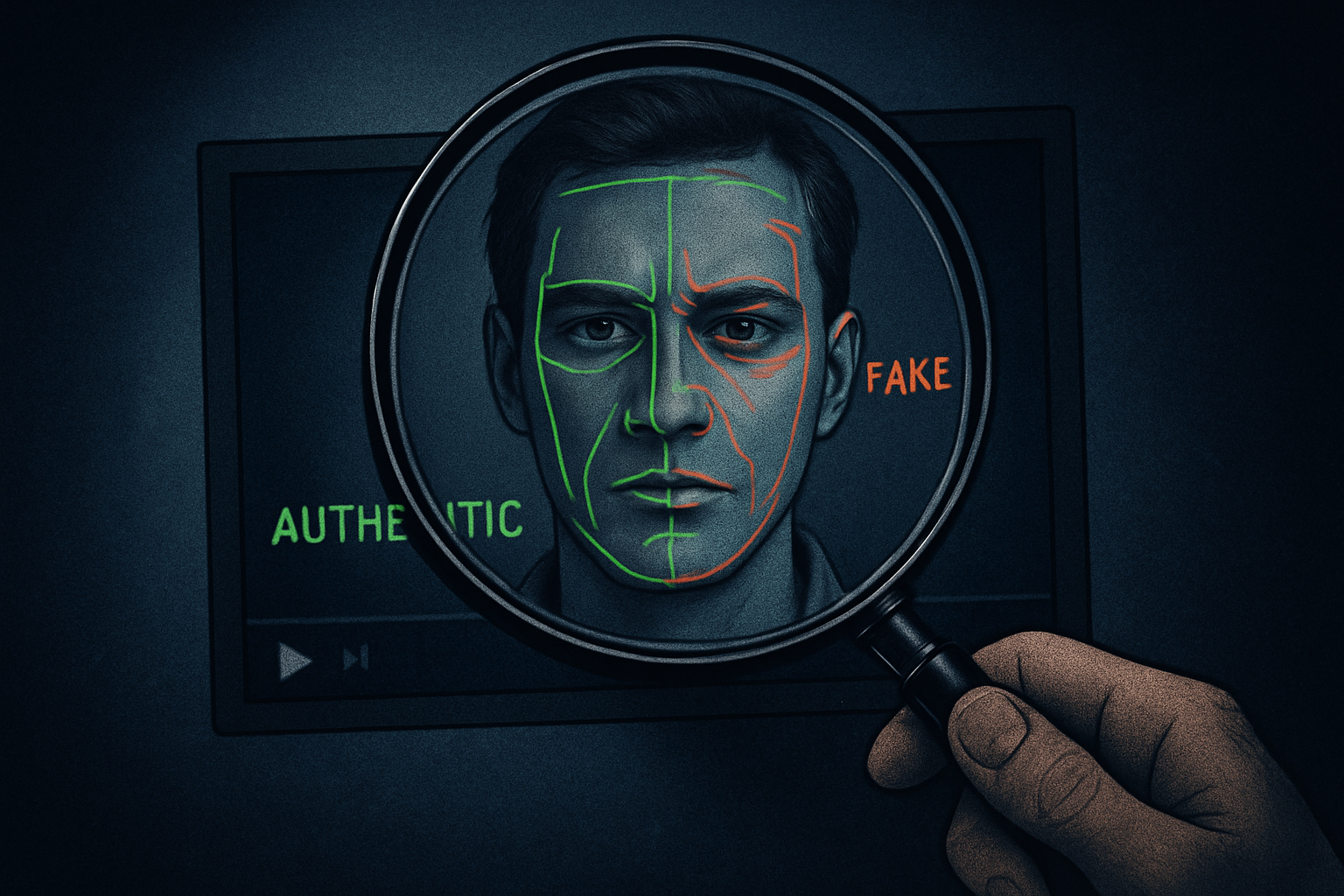
A video surfaces showing a
public figure announcing something shocking. It spreads instantly across social
media platforms. Millions of people see it. Hours later, fact-checkers confirm
it was a deepfake — AI-generated fabrication indistinguishable from reality to
casual viewers. The damage is done: beliefs have shifted, decisions have been
made, and corrections never travel as far as the original lie.
This scenario plays out
repeatedly. Deepfake technology has advanced from a novelty to a genuine
information security threat. Understanding how to detect deepfakes is now a
basic media literacy skill. This guide provides specific, practical detection
techniques and tools that any person can use.
What Are Deepfakes and How Are They Created?
Deepfakes use machine learning
techniques — primarily Generative Adversarial Networks (GANs) and diffusion
models — to synthesize realistic-looking media. In a face-swap deepfake, one
person's face is mapped onto another person's body in video with such accuracy
that the substitution isn't immediately obvious. Audio deepfakes clone voices
from reference recordings and synthesize speech the target never actually said.
Full synthetic deepfakes generate entirely artificial people who look and sound
real.
The technology has become
disturbingly accessible. Several free tools enable high-quality deepfake
creation without technical expertise. The barrier is now primarily time and
intent, not skill or resources.
9 Visual and Behavioral Clues to Look For
Clue 1: Unnatural Blinking Patterns
Humans blink naturally every 3-5
seconds in a pattern that varies with context and emotion. Early and many
current deepfakes struggle with natural blinking — producing either no
blinking, too-frequent blinking, or geometrically inconsistent eye closure.
Watch the eye area across 15-20 seconds of video specifically looking for blink
timing.
Clue 2: Facial Boundary Inconsistencies
The edge where a swapped face
meets the original neck, ears, and hair is technically challenging and often
imperfect. Look specifically at: the hairline and where hair meets the
forehead, the jaw-neck boundary particularly during head movements, the area
around the ears, and the boundary between facial skin and clothing. Blurring,
color mismatches, or geometric distortions in these areas are strong indicators.
Clue 3: Lighting and Shadow Inconsistencies
Deepfakes often struggle to
perfectly match the lighting of the face to the lighting of the surrounding
environment. The key questions: does the light source direction match between
the face and the background? Do shadows on the face fall in geometrically
consistent directions? Is the skin tone consistent with the ambient lighting
color? Mismatch in any of these suggests manipulation.
Clue 4: Teeth and Mouth Area
Detailed dental rendering is a
specific weakness of many deepfake systems. Look for: unrealistically uniform
or pristine teeth, blurring or distortion inside the open mouth, lip movements
that don't perfectly synchronize with audio, and lip color that doesn't match
surrounding facial skin tone. These details are subtle but visible on close
inspection.
Clue 5: Ear and Jewelry Details
Ear geometry is complex and
individual — deepfakes frequently produce simplified or distorted ears. Jewelry
in video, particularly earrings that move with head movement, often renders
incorrectly or shows flickering artifacts. These details deserve specific
attention on close inspection.
Clue 6: Hair Physics and Movement
Individual hair strands moving
naturally with head motion are computationally expensive for deepfake systems.
Look for: hair that moves as a single mass rather than individual strands, hair
that doesn't physically interact with shoulders or clothing, and strands that
flicker or disappear at frame boundaries.
Clue 7: Background Warping
Particularly in video deepfakes,
the background near the face sometimes warps, stretches, or shows color bleed
artifacts, especially during fast head movements. Pause and frame-advance
through sections with rapid movement to look for these temporal artifacts.
Clue 8: Emotional Expression Disconnects
Genuine emotional expression
involves micro-expressions, asymmetries, and muscle movement patterns that are
extremely difficult to synthesize convincingly. If the emotional expression in
the voice doesn't match the emotional expression on the face, or if facial
expressions seem slightly delayed or artificial, this warrants scrutiny.
Clue 9: Source and Context
Who created this content, when,
and where was it first published? A video that appears on unknown channels,
claims to show a highly convenient piece of information, and cannot be found in
mainstream news sources should be treated as potentially fabricated regardless
of its visual quality.
5 Free Deepfake Detection Tools
Microsoft Video Authenticator
analyzes photos and videos to provide a confidence score for potential
manipulation. Sensity AI's free tier offers basic deepfake detection for images
and video. FotoForensics uses error level analysis to detect image manipulation
— free and web-based. InVID/WeVerify is a browser extension specifically
designed for news verification that analyzes images and video metadata. Reality
Defender offers API access for developers building deepfake detection into
platforms.
Conclusion
Deepfake detection is an ongoing
arms race between creation and detection technology. The techniques in this
guide won't catch every sophisticated deepfake — but they will catch most
circulating examples, which remain technically imperfect. Applying even 3-4 of
these checks before sharing viral video content significantly reduces your
likelihood of spreading deepfake misinformation. In a landscape where
AI-generated deception is increasing, media literacy is a critical individual
responsibility.