The two biggest obstacles to
language learning are consistent practice opportunity and immediate corrective
feedback. Getting to conversational fluency traditionally required either
living in a country where the language is spoken or paying for regular tutoring
— both expensive and logistically complex options.
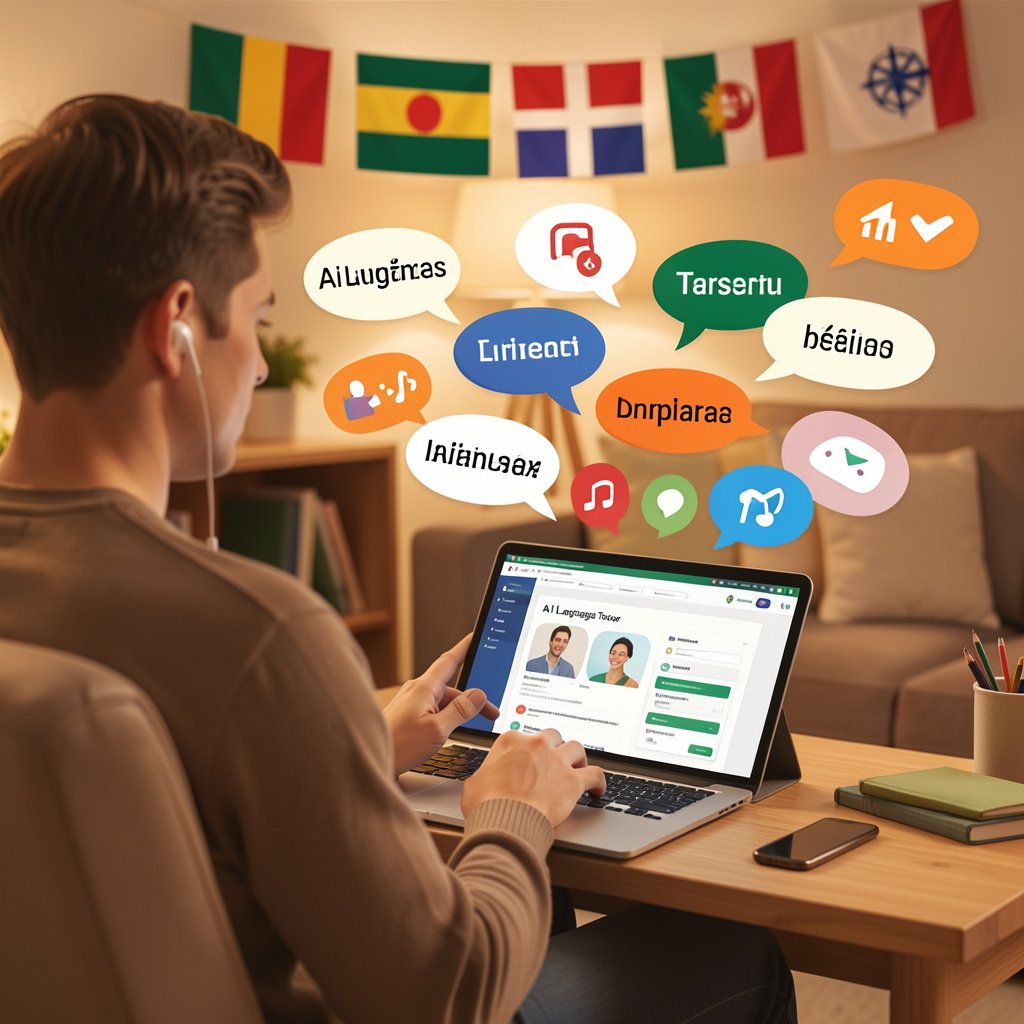
AI in 2026 eliminates both
obstacles. You can practice conversation with an AI at 11pm when your tutor is
unavailable. You can get immediate, gentle correction every time you make a
grammar error. You can ask for an explanation of a phrase you heard in a show
and get it instantly. This guide covers ten specific AI-powered methods that
work based on principles of effective language acquisition.
The Science of Why AI Works for Language Learning
Language acquisition research
consistently identifies several conditions that accelerate learning:
comprehensible input slightly above your current level, repeated exposure to
target structures in varied contexts, low-anxiety production practice, and
immediate corrective feedback. AI tools uniquely satisfy all four conditions
simultaneously. The AI adjusts to your level, provides varied contexts on
demand, creates a judgment-free practice environment, and corrects errors in
real time.
Method 1: The Daily Conversation Partner Session
Use this prompt with ChatGPT:
'I'm learning [language] at [level: beginner/intermediate/advanced]. Let's have
a 10-minute conversation about [topic]. Speak to me in [language]. When I make
grammar mistakes, correct me gently but keep the conversation flowing. Use
vocabulary appropriate for my level.' Do this daily for 15-20 minutes. The
compound effect of daily production practice — even with an AI — is
substantial. Most learners find they've internalized new vocabulary and
structures within 2 weeks of this practice.
Method 2: The Sentence Correction Loop
Write 5 sentences in your target
language about anything. Submit them to ChatGPT with: 'Here are 5 sentences I
wrote in [language]. Correct any errors, explain the grammar rule behind each
correction, and give me a more natural way to express the same idea.' This
technique addresses the gap between knowing a rule and applying it naturally —
the specific failure mode of classroom-based language learning.
Method 3: Vocabulary in Context (Not Vocabulary Lists)
Vocabulary lists are an
inefficient way to learn words. Prompt ChatGPT: 'I want to learn 10 new
[language] words related to [topic: cooking/business/travel]. For each word,
give me: the word, its meaning, 2 example sentences showing it in different contexts,
any common collocations (words it frequently appears with), and a memory tip.'
Learning words with context and connection triples retention compared to
isolated list memorization.
Method 4: Grammar Explanation on Demand
When you encounter a grammar structure
you don't understand — from a book, show, or conversation — ask: 'In
[language], I saw the phrase [phrase]. Can you explain the grammar rule being
used here, give me 3 more examples of this structure, and create a
mini-exercise where I practice it?' This just-in-time grammar instruction, tied
to content you actually encountered, produces far better retention than
studying grammar chapters in sequence.
Method 5: Shadowing Practice With AI Explanations
Shadowing — listening to native
speech and repeating it simultaneously — is one of the most effective
pronunciation and rhythm exercises. Use AI to enhance it: ask ChatGPT to give
you a short (3-4 sentence) paragraph in your target language at a natural
speaking pace, then ask it to break down each sentence with pronunciation
notes, stress patterns, and connected speech features. Shadow the paragraph ten
times, then have the AI evaluate a transcript of what you said.
Method 6: Immersion Content Comprehension Aid
Watch a 5-minute segment of a
show or listen to a podcast in your target language. Pause and write down
everything you didn't understand — phrases, words, structures. Submit to
ChatGPT: 'I watched a clip in [language] and didn't understand these phrases:
[list]. Can you explain each one including any cultural context I need?' This
transforms passive immersion content into active learning material.
Method 7: AI Role-Play Scenarios
Practical fluency requires
vocabulary and patterns for specific life situations. Prompt: 'I need to
practice asking for help at a train station in [language]. Play the role of a
helpful but slightly impatient station employee. Stay in character. If I make
mistakes, respond naturally as a real person would but then give me a
correction note afterward.' Role-play in specific scenarios builds the exact
vocabulary you need for actual situations.
Method 8: Translation Comparison Learning
Take a sentence in your native
language that you want to express in the target language. Translate it yourself
first, then ask the AI to provide its translation and compare the two. 'Here's
my attempt to say X in [language]: [your attempt]. Here's what I was trying to
say in English. How accurate is my attempt? What's more natural way to express
this?' The comparison reveals the specific gap between your current and target
proficiency.
Best AI Tools for Language Learning in 2026
ChatGPT (any tier): Best
all-around conversation practice and explanation tool. Duolingo Max (paid
tier): Includes AI roleplay and detailed grammar explanations powered by GPT-4.
Elsa Speak: Specifically for English pronunciation with AI speech recognition
feedback. Pimsleur: Audio-focused AI-guided learning, best for auditory
learners. Anki with AI-generated cards: Flashcard spaced repetition system —
use AI to generate comprehensive cards faster.
Conclusion
AI doesn't replace the effort of
language learning — producing fluent language is always going to require
extensive practice and exposure. What AI does is remove the access barriers
that previously limited that practice: availability, cost, and the
self-consciousness of making mistakes in front of a human. With 30-40 minutes
of intentional AI-assisted practice daily, learners consistently reach
conversational proficiency in 6-9 months for closely related languages. The
methods in this guide give you a structured approach to maximize those 30-40
minutes.